Press release, 28.11.2025.
Official statistics is not an opinion
The revision on data on poverty by the Hungarian Central Statistical Office (HCSO) concluded in the fall on 2025, being coordinated with the Statistical Office of the European Union, Eurostat. Several misleading statements surfaced during the past weeks, lacking any professional basis. In contrast to claims by certain researchers and journalists, previously planned professional work and not external pressure are in the background of the revision process. Revision is a standard procedure of the statistical data production process, not only in Hungary but internationally, too: other countries also applied this method during the past years. The revision did not change the familiar trends of poverty indices, the main poverty index did not change in merit neither in its level nor its trend. Hungary’s position significantly improved since 2010, the dynamics of the main poverty index surpassed notably the EU average, and its level is also more favourable since 2017 than the EU average. Based on the most recent comparable data Hungary is the 13th in the rank of the EU member states.
What is EU-SILC and why is it important?
The HCSO collects data on a yearly basis in the EU statistics on income and living conditions (EU-SILC) framework about the income and living conditions of households, as well about their housing conditions and other characteristics. Analysing the trends on poverty and social exclusion are in the focus of the data collection. Data of the survey are indispensable in preparing as well as monitoring significant social and economic decisions affecting families, employees, pensioners, and the population as a whole. The data collection is conducted in all European Union member states based on a unified methodology.
Revision is not an extraordinary, but a standard EU procedure
In statistics, the process of modifying already published data is called revision. It is not an unusual occurrence, rather an integral part of the statistical process. The main goal of revision is quality improvement of information and through it, – in conformity with the aim of statistics – the exact description of the phenomena in question, as accurate presentation of reality as possible. Revision as such is a standard procedure of the statistical data production process, not only in Hungary but internationally, too.
Present review took place based on a previously determined professional schedule, not due to any media coverage. The HCSO informed researchers in 2023, then Eurostat in 2024 about it, as such the “revision due to pressure from the media” narrative is factually untrue. Both the original data series and the re-weighted ones have been verified and approved by Eurostat.
Accuracy and reliability
The revision has been carried out for the 2018-2023 period by the HCSO, based on recommendation from Eurostat. It was a necessary step, as the final data of the 2022 census differed from the estimated data on population from the previous years. As a result of the revision the obstruction of income distribution, the contradiction between net and gross earnings, and the excessive fluctuation of the poverty gap ceased.
What changed and what remained?
The revision did not change poverty trends which continue to improve in Hungary.
Proportion of those at risk of poverty or social exclusion before and after revision
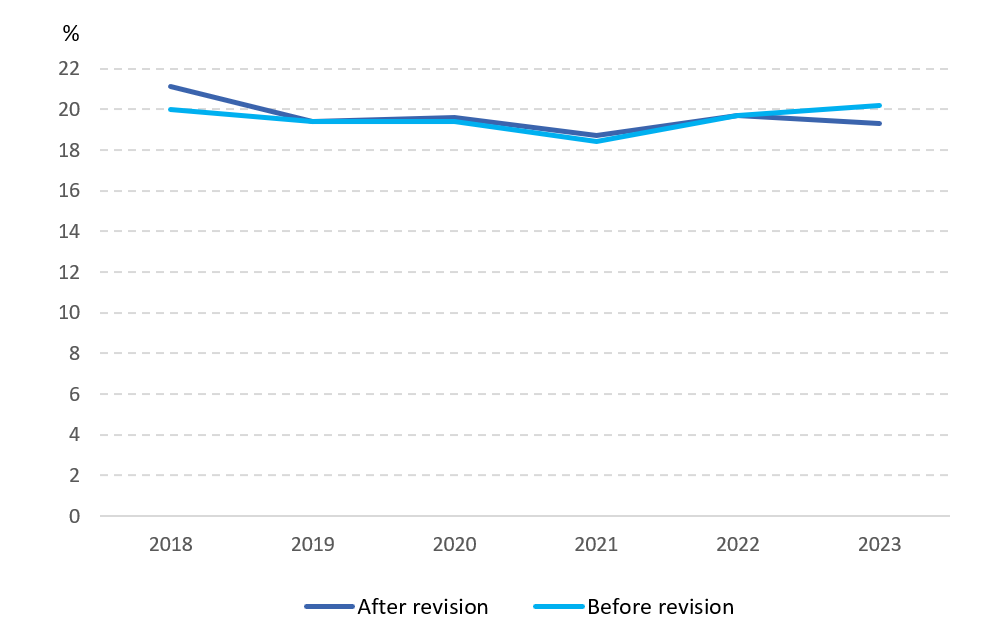
The state of poverty significantly improved between 2010 and 2024 in Hungary. The pre-planned revision did not change in merit the level or trend of the main poverty index for Hungary. The dynamics of the main poverty index surpassed notably the EU average since 2010, and its level is also more favourable since 2017 than it.
Main messages of the EU-SILC data revision
-
The focus of EU-SILC survey is on the study of the trends of poverty or social exclusion.
-
The number of those at risk of poverty or social exclusion decreased by more than 40%, or 1 million 274 thousand, between 2010 and 2024 in Hungary.
-
The living conditions of vulnerable social groups improved significantly as well between 2010 and 2024.
-
The revision was pre-planned, carried out due to the re-weighting based on the 2022 new survey’s population data.
-
The change in proportion of those at risk of poverty or social exclusion remained within the sampling margin of error in each revised year.
-
Certain groups of the population have been slightly redistributed in regard to their risk of poverty.
-
Based on the most recent comparable data the main poverty index of Hungary is the 13th in the rank of the EU member states.
-
Hungary’s position significantly improved within the EU since 2010.
-
Revision is an internationally accepted procedure, serving the purpose of obtaining more reliable data and it is an integral part of the Eurostat’s official statistics framework.
The detailed EU-SILC official statistical background material, figures and international comparison available on below link.
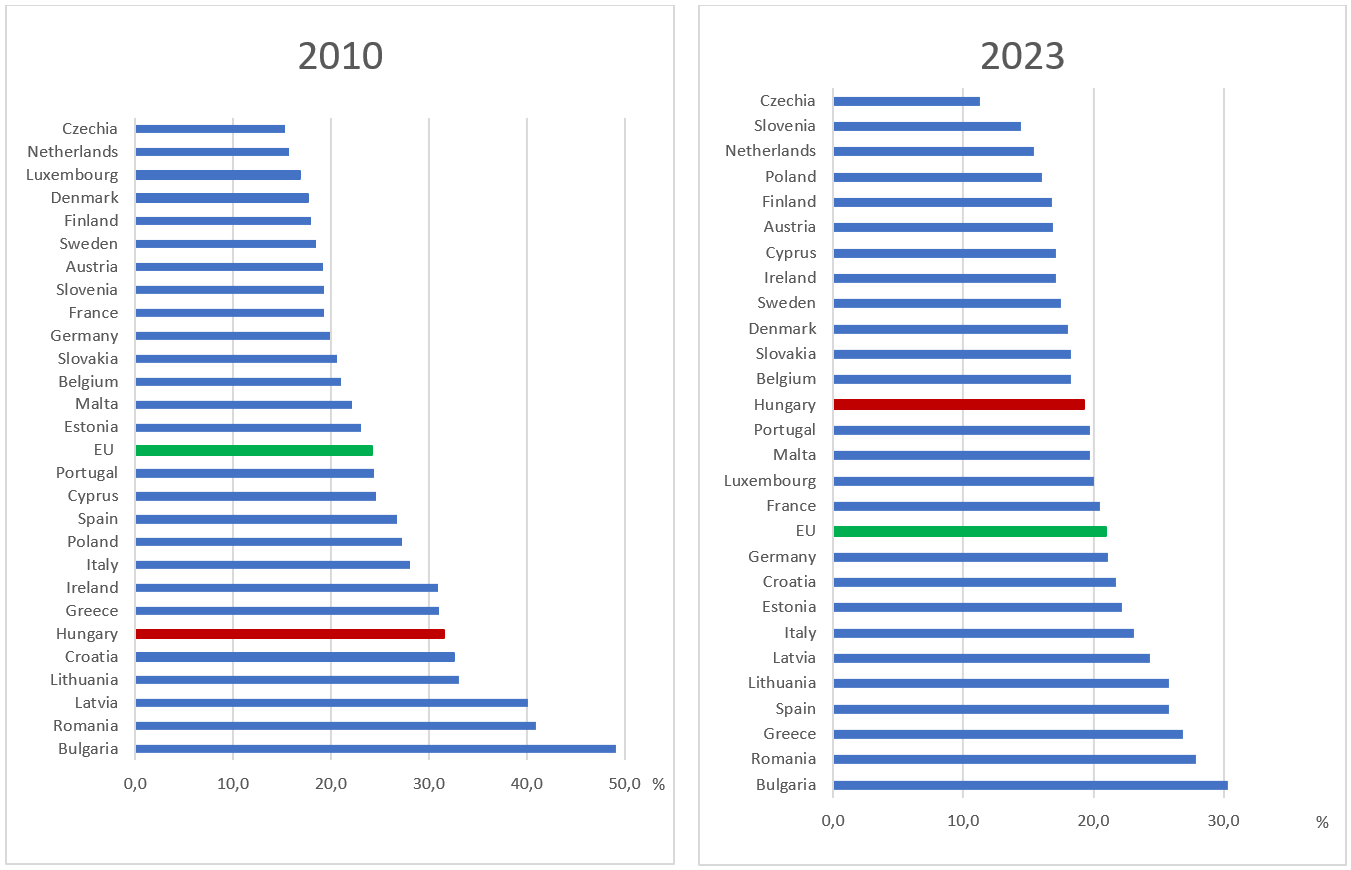
Hungary’s position within the EU significantly improved: while 5 countries had higher numbers of people at risk of poverty or social exclusion in 2010, according to the most recent comparable data (2023) 14 countries show worse indices than Hungary.
Proportion of those at risk of poverty or social exclusion in the member states of the European Union
Revision is an internationally accepted procedure, serving the purpose of obtaining more reliable data and it is an integral part of the Eurostat’s official statistics framework. Eurostat support through regular methodological and revision recommendations the constant improvement of data accuracy and reliability. All revisions and methodological supervisions are a natural component of statistical data processing, and causes time series breaks: the revision of the main index had a similar effect in each country and further time series breaks occur in the data series of other 14 countries. Eurostat is monitoring the work of the HCSO in the case of the EU-SILC data collection on a yearly basis, generally, within a peer review framework, multi-annually, data are validated and published.
Trust and verifiability exclude the possibility of manipulation
Statistical data reliability depends on two basic conditions: methodological transparency and independent verification. The HCSO communicated in a transparent, open manner the results and methodology of the EU-SILC data collection and that of the revision toward the general public and researchers. Eurostat verified and certified both the original numbers and the revised ones, guaranteeing data reliability, excluding the possibility of deliberate manipulation, accusations the HCSO was faced with by certain researchers.
Let us rely on facts, not impressions !
The strength of statistics is its resistance to momentary impressions and interest-based interpretations, as official statistics reflects the reality, not an opinion.
The duty of the HCSO is measuring reality in as accurate and transparent manner as possible. The independence of the Office, its adherence to international standards, its professionalism is guaranteeing that data reflect phenomena in a reliable, authentic, and exact manner, as such they may serve as points of reference in evaluating the state of the country. This is why it is extremely harmful and irresponsible every unfounded statement that is aiming to degrade the credibility of the Hungarian Central Statistical Office. The HSCO is committed to transparency, professional integrity as well as independence and it is open to worthwhile dialogue.
Hungarian Central Statistical Office
H-1024 Budapest, Keleti Károly utca 5–7. Phone number: (+36-1) 345-6000
Postal address: H-1525 Budapest, P.O.Box 51
www.ksh.hu