Health care, accidents
In addition to lifestyle factors, health status is significantly influenced by the preparedness of the health care system. Health statistics provides data on the health status of the population, the presence of lifestyle risks having the strongest impact on the health of the population, the most common diseases and on how much the population does for their health. It monitors changes in the material, personnel and financial conditions that ensure the functioning of the different levels of the care system. Accident statistics takes account of traffic accidents in the country, in particular, it deals with road traffic accidents causing personal injury.
Key figures
Health expenditure as a percentage of GDP
Indicator description
Health expenditure as a percentage of GDP calculated according to the international methodology of health accounts.
Source of data:
Summary Tables (STADAT)
Last data for period: 2023
Active physicians per ten thousand inhabitants
Indicator description
Among doctors admitted to the national medical register, the number of those who are active per ten thousand inhabitants.
Source of data:
Summary Tables (STADAT)
Last data for period: 2025
Inhabitants per GP and family paediatrician
Indicator description
Number of inhabitants per general practitioner and family paediatrician working in an adult, mixed or child practice.
Source of data:
Summary Tables (STADAT)
Last data for period: 2024
Number of hospital beds suitable for hospitalisation that can be actually used per ten thousand inhabitants
Indicator description
Number of hospital beds suitable for hospitalisation per ten thousand inhabitants. A hospital bed suitable for hospitalisation is an approved bed that has been suitable for hospitalisation for at least 6 months.
Source of data:
Summary Tables (STADAT)
Last data for period: 2024
Featured
HCSO Monitor
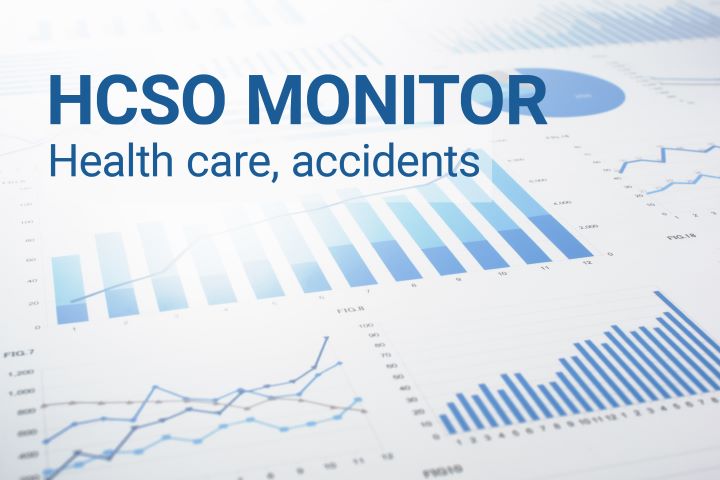
The collection of interactive figures provides up-to-date information on the latest domestic and international socio-economic trends. The decisive part of the figures included in HCSO Monitor are downloadable in both image and data formats (PNG, SVG and CSV). Feel free to browse the data in HCSO Monitor, updated many times a week!

Statistical Pocketbook of Hungary, 2025
The tables and charts in the latest edition of the Statistical Pocketbook of Hungary provide a comprehensive insight into the development of social and economic trends in Hungary during the year 2024. It aims to provide a summary picture of the country's situation in all possible areas based on preliminary indicators. In this year’s pocketbook, alongside the NACE Rev.2 classification, we also publish the number of business units according to the new NACE Rev.2.1 structure, as well as foreign trade data compiled under the new methodology.

Hungary 1st-3rd quarters of 2025 – Continuously increasing consumption
The performance of Hungary’s economy surpassed the previous year’s level by 0.3% in the 1st-3rd quarters of 2025. The increasing performance of the services sector and construction as well as growing consumption had a positive impact on GDP. These impacts however have been subdued by the setback of the industry and agriculture, the continuously subdued investment activity. Retail trade volume continued to rise, foreign demand at accommodation establishments increased, too.

Snapshots, 2024 - Health care
In 2024, nearly two-thirds of the Hungarian population aged 16 and older were satisfied with their health; men felt this way at a rate almost 6 percentage points higher than women. In connection with the healthcare wage increases of recent years, the number of active physicians per ten thousand inhabitants increased from 44 to 45 in one year. At the same time, the number of general practitioners and family paediatricians continued to decrease; their number was 5,469 in 2024, an average of 5.7 per ten thousand inhabitants.

Statistical Yearbook of Hungary, 2024
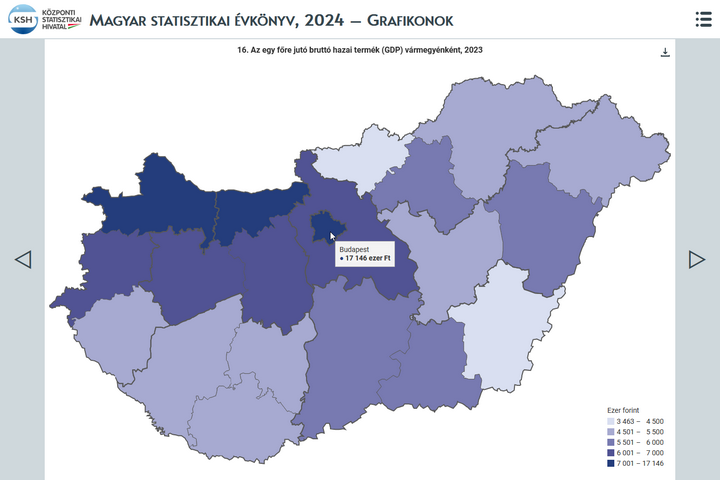
The yearbook provides an overview of Hungary's demographic, social and economic trends, environmental characteristics and their changes over time, with the help of tens of thousands of data in some 500 tables, charts and maps. In the chapter devoted to earnings and incomes, it is a novelty compared to previous years that net earnings in which allowances and types of exemptions are accounted for, too, came into focus from 2019. In the number of employees, people working in working time shorter than 60 working hours per month are also taken into account. In addition, the theme of environment is completed with areas declared world heritage sites by UNESCO.

Hungary, 2024
Hungary’s GDP increased by 0.5% amid global challenges in 2024. The performance of goods-producing industries lessened, while that of service-providing ones rose, which shows the duality of economic trends. Household consumption picked up, which was considerably encouraged by the purchasing power of earnings growing again with the inflationary wave calming down. Besides, the data series reveal that the level of employment reached another peak.

Findings of the European Health Interview Surveys in one place
Health interview surveys to be conducted every five years allow us to monitor the changes in the health status of the population and reveal the correlations between health status and the background factors influencing that. Due to the users’ increased interest, we acquaint the general public with the results of the three most recent surveys in our now published table collection – following extensive data processing – in a comparable manner, classified in 11 themes, together with the methodology.
Related themes
- International data
- Men and women
- Population and vital events
- Regional statistics
- Transport
- The young and the elderly
Methodological information
Related links
Release and revision calendarPublication repertory
Census data |
Census |
|---|---|
| Census 2022 database | Population census 2022 |
| 6. National and county data | Population census 2001 |
| 12. Disabled persons | Population census 2001 |
Data visualisations