The young and the elderly
The ageing of the Hungarian and European population, that is, the increase in the proportion of the elderly and the simultaneous decrease in the proportion of the young is a long-term process. During the change in the demographic makeup of society, we can observe differences in the living conditions of social groups of various ages, and the change in certain processes and phenomena (e.g. start of career, retirement) are connected to certain clearly delineable age groups. On this page we have collected contents by age group and about special age groups from various statistical domains.
Key figures
Ageing index
Indicator description
The number of elderly population aged 65 years and older per 100 individuals younger than 14 years old. If the score is more than 100, then the number of elderly population overpasses that of child-aged population.
Source of data:
Summary Tables (STADAT)
Last data for period: 2026
Employment rate of the population aged 25–29
Indicator description
The share of employed persons aged 25–29 in the population of the same age.
Source of data:
Summary Tables (STADAT)
Last data for period: Q4 2022
Relative poverty rate of the population aged 0–17
Indicator description
Proportion of persons aged 17 and under living in households with less than 60% of median equivalised income. Median equivalised income: after ranking the total population by OECD2 income per consumption unit, the income in the middle of the ranking is the median, i.e. exactly the same number of people have less or more income.
Source of data:
Summary Tables (STADAT)
Last data for period: 2024
Average pension or benefit amount as a percentage of average net nominal earnings
Indicator description
Monthly average of pensions and other benefits paid by the Central Administration of National Pension Insurance as a percentage of average net earnings.
Source of data:
Summary Tables (STADAT)
Last data for period: 2025
Featured

International Day of Older Persons, 1 October 2026
As a result of a decision adopted by the United Nations General Assembly in December 1990, 1 October is observed as the International Day of Older Persons. European society is ageing at an increasing rate. In the European Union, 22% of the population was aged 65 and older at the beginning of 2025; in Hungary, this share was slightly lower, at 21%. On 1 January 2026, nearly 2 million people in Hungary were aged 65 and older. Their number had increased by 12% compared to 2016. Zala County had the highest proportion of older persons, at nearly 26%.

Hungary, 2025
For Hungary, 2025 once again proved economically two?sided: while output in the productive sectors—industry and agriculture—continued to weaken, services strengthened across almost all areas. Household consumption gained further momentum, supported in large part by the rise in real wages. Based on the available data, employment levels appear to have stabilised at a high level despite the protracted global difficulties.

Statistical Yearbook of Hungary, 2025
The yearbook provides an overview of Hungary's demographic, social and economic trends, environmental characteristics and their changes over time, with the help of tens of thousands of data in some 500 tables, charts and maps. Compared to previous years, it is a novelty that the results of time use data collection showing the time use of the population were included in the yearbook, furthermore, that the number of registered organisations and earnings data are also available according to the new NACE Rev. 2.1 structure, alongside the NACE Rev. 2 classification, as well as that the International data chapter is published with more extensive content, various indicators.

Nurseries Day
Nurseries Day in Hungary is celebrated on 21 April, marking the opening of the country’s first nursery in 1852. In 2025, more than 62 thousand young children were receiving daytime care in 2,990 institutions. The number of enrolled children showed steady growth over the years—apart from 2020, which was affected by the COVID-19 pandemic—and in 2025, nurseries cared for 42% more children than eight years earlier. Most young children attended traditional nurseries; however, from 2017, the number of children using mini infant nursery services grew at the fastest rate.
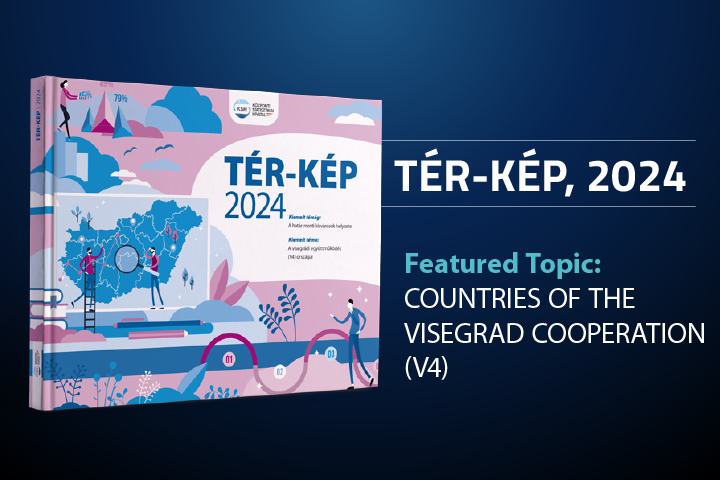
TÉR-KÉP, 2024 – Countries of the Visegrad Cooperation (V4)
If the Visegrad Four (V4) would be considered as one single country, it would be the third most populous state and the fifth largest economy within the EU. Hungary registered the highest median age among the four countries, at the same time the proportion of those using the internet was on average the highest in our country. The economic activity indices of the V4 countries were more favourable than the EU average. The complete publication is available in Hungarian at: TÉR-KÉP, 2024

Hungary 1st-3rd quarters of 2025 – Continuously increasing consumption
The performance of Hungary’s economy surpassed the previous year’s level by 0.3% in the 1st-3rd quarters of 2025. The increasing performance of the services sector and construction as well as growing consumption had a positive impact on GDP. These impacts however have been subdued by the setback of the industry and agriculture, the continuously subdued investment activity. Retail trade volume continued to rise, foreign demand at accommodation establishments increased, too.
Related themes
- Censuses
- Education
- Health care, accidents
- Income and consumption
- Justice
- Labour
- Living conditions
- Population and vital events
- Social care protection
- Time use
Data visualisations